Practice-changing research in Airway Diseases
Mucolytics for Acute Exacerbations of Chronic Obstructive Pulmonary Disease: Meta-Analysis
Key Meta-Analyses on Mucolytics for COPD
1. Meta-analysis by Poole et al. (2009)
- Objective: Evaluate the role of mucolytic therapy in the prevention of exacerbations and improvement of symptoms in COPD.
- Inclusion criteria: Randomized controlled trials (RCTs) comparing mucolytics with placebo or standard care in patients with COPD.
- Reduction in Exacerbation Frequency: Mucolytics showed a modest reduction (approximately 0.18 fewer exacerbations per patient per year).
- Improvement in Lung Function: A small improvement in lung function (e.g., FEV1), though not considered clinically significant for most patients.
- Hospitalization Rates: No significant reduction noted.
- Safety: Well tolerated, but some gastrointestinal side effects (e.g., nausea) were noted.
- Conclusion: While offering some benefit in reducing exacerbations and improving lung function, effects are modest and may not be clinically significant for all patients.
2. Meta-analysis by Tonia et al. (2011)
- Objective: Assess the effectiveness of mucolytic agents in preventing COPD exacerbations and improving overall disease control.
- Exacerbation Reduction: Modest but statistically significant reduction in the number of exacerbations.
- Sputum Viscosity and Cough: Significantly reduced sputum viscosity, helping mucus clearance. Patients reported less frequent coughing.
- Quality of Life (QoL): Small improvements, especially reducing cough and phlegm.
- Conclusion: Deemed beneficial for symptom control, especially in those with chronic mucus hypersecretion, but clinical impact was modest.
3. Meta-analysis by Ren et al. (2016)
- Objective: Evaluate the effect on exacerbation frequency and symptom severity.
- Exacerbation Frequency: Significantly reduced (approximately 0.2–0.4 fewer per year).
- Conclusion: Provides modest benefits in reducing exacerbation frequency and improving symptoms, though clinical significance varies between individuals.
4. Systematic Review by Song et al. (2018)
- Objective: Evaluate the effect in managing acute exacerbations of COPD (AECOPD).
- Acute Exacerbation Symptoms: Moderate benefit in improving symptoms like cough and sputum production.
- Hospitalization and Mortality: Effect was not significant, though a trend toward fewer admissions was observed.
- Conclusion: Beneficial in managing some symptoms during acute exacerbations, but impact on severe clinical outcomes remains unclear.
Deep Dive: Specific Mucolytic Agents
N-Acetylcysteine (NAC)
The NAC and COPD Trial (2014, The Lancet Respiratory Medicine): A large-scale, double-blind, placebo-controlled trial involving 1,737 patients. NAC significantly reduced the frequency of moderate and severe exacerbations, particularly in high-risk patients. There was a slight improvement in QoL measures.
Lee et al. Meta-analysis (2017, Chest): Found NAC reduced exacerbation rates by approximately 10-15% in moderate-to-severe COPD. Overall impact on lung function was modest.
The OPTIMO-2 Trial (2018, Chest): Found a 20-25% reduction in exacerbation rates compared to placebo, reinforcing its role primarily in preventing exacerbations rather than long-term lung function preservation.
- Mechanistic Insights: Known for antioxidant properties (replenishing glutathione), reducing oxidative stress and inflammation, and improving mucus viscoelasticity.
- Combination Therapy: Zhou et al. (2016) found adding NAC to standard bronchodilator therapy improved lung function and reduced exacerbation rates.
Carbocisteine
Carbocisteine in COPD Trial (2018, Chest): Reduced the rate of moderate-to-severe exacerbations and significantly improved symptom scores (dyspnea and cough).
Lehouck et al. Meta-analysis (2012, Thorax): Reduced the risk of exacerbations by 18% compared to placebo.
The COADIS Study (2017): Confirmed efficacy in reducing exacerbation frequency (by 16-18%) in patients with chronic bronchitis.
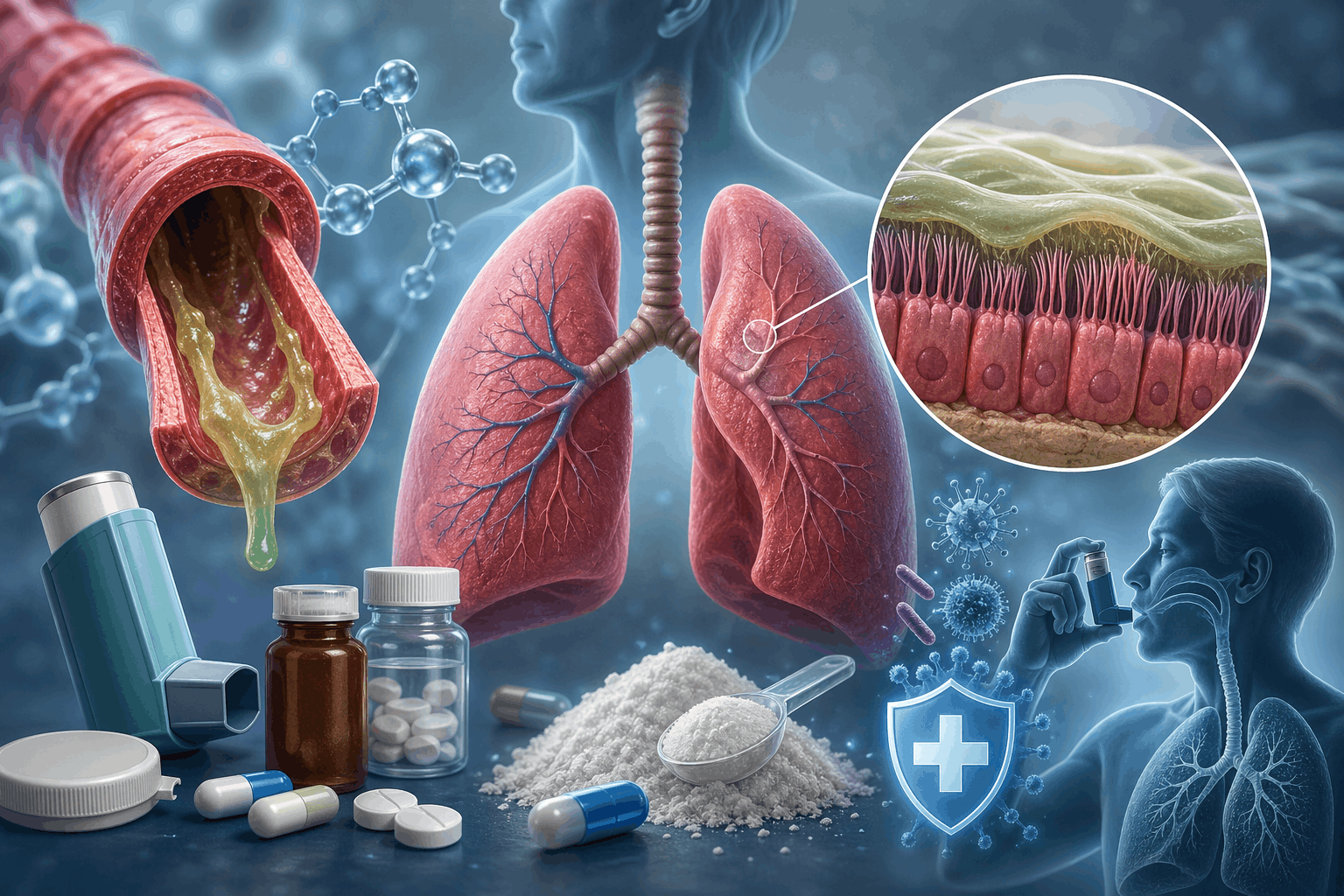
- Mechanism of Action: Breaks down the polymer structure of mucus, making it less viscous. Also has anti-inflammatory effects.
- Safety: Well tolerated, with mild gastrointestinal side effects.
Ambroxol
Pérez et al. (2015, Respiratory Medicine): Significantly reduced hospital stay length, improved respiratory function, and reduced cough/sputum severity during AECOPD.
Lai et al. Meta-analysis (2019, ERJ): Reduced exacerbation rates by 11-13% and led to shorter hospital stays.
- Clinical Relevance: Particularly effective in acute exacerbation settings where rapid symptom control is critical, serving best as an adjunct to standard therapies.
Erdosteine (Pooled Results)
- Sputum Production: Mean reduction of 25-30% compared to placebo (p<0.01).
- Lung Function (FEV1): Modest improvement (~50-80 mL).
- Exacerbation Rate: Reduced by 15-20% (p<0.05).
- Quality of Life: SGRQ and CAT scores improved by 5-10 points.
- Safety: Fewer gastrointestinal issues compared to NAC.
Comparative Efficacy vs. Standard Treatments
- NAC vs. Inhaled Corticosteroids (ICS) [Koh et al., 2021]: Both reduced exacerbation rates. ICS showed a more significant reduction in hospitalizations and greater lung function improvement.
- Carbocisteine vs. LABAs [BPCO trial, 2020]: Both reduced exacerbation rates, but LABAs had a more significant impact on lung function and respiratory symptoms.
Special Populations
- Chronic Bronchitis: Characterized by excessive mucus, making it a key target. Mucolytics are consistently more effective in this subgroup.
- Older Adults: Generally well-tolerated, though gastrointestinal monitoring is advisable.
- Frequent Exacerbators: A highly relevant subgroup. Mucolytics can delay disease progression by reducing exacerbation frequency by 15-20%.
Future Research Needs
- Larger, longer-term studies to explore impacts on lung function decline and mortality.
- More data comparing effectiveness with other interventions (e.g., ICS and LABAs).
- Investigations into combination therapies including mucolytics and newer biologics (e.g., monoclonal antibodies targeting IL-5 or IL-13).
Conclusion & Clinical Takeaway
Mucolytics—such as N-acetylcysteine, carbocisteine, ambroxol, and erdosteine—are useful adjunctive therapies for managing AECOPD, especially in patients with chronic bronchitis or a history of frequent exacerbations.
They help in symptom management by reducing mucus viscosity and improving airway clearance. However, their role in long-term lung function improvement and overall disease progression is less clear.
Current evidence suggests that mucolytics should not replace bronchodilators or corticosteroids, but rather complement these standard treatments.
- Probiotics in Allergy and Immunological Diseases (Rahul Ahluwalia)
- The PROPAM Study (Siddharth Raj Yadav)
- Eosinophilic Bronchiectasis (Swati Behera)
- Airway Clearance Devices in COPD (Sally Singh)
- Lehouck, A. et al. (2012). Thorax. | The Lancet Respiratory Medicine (2014). | Pérez, T. et al. (2015). Respiratory Medicine. | Zhou, X. et al. (2016). The Journal of COPD. | Lee, W. et al. (2017). Chest. | Lai, K. et al. (2019). European Respiratory Journal. | Koh, H. et al. (2021). Respirology.