Dr. Tony Luke is renowned for his dedication, having performed continuous 24-hour duties for several years at prestigious institutions. He focuses on detailed history taking and concerned investigations to create personalized care plans.
Dr. Tony's practice focuses on Root Cause Analysis to provide permanent solutions for both short-term and long-term health issues. He emphasizes early diagnosis and treatment for hereditary conditions like Allergy & Asthma, particularly in childhood.
Specialist
Senior Resident (Pulmonology)
Junior Consultant
Visiting Consultant
Consultant & Head
AP & Professor
Pulmonology Senior Consultant
Senior Consultant & Head
Senior Consultant
Fellow of The American College of Chest Physicians (USA)
Fellow of Asian Pacific Society of Respirology (Japan)
Diploma in Pediatric Sleep Medicine
Fellow of United Academy of Pulmonary Medicine
Diploma in Pediatric Pulmonary Medicine
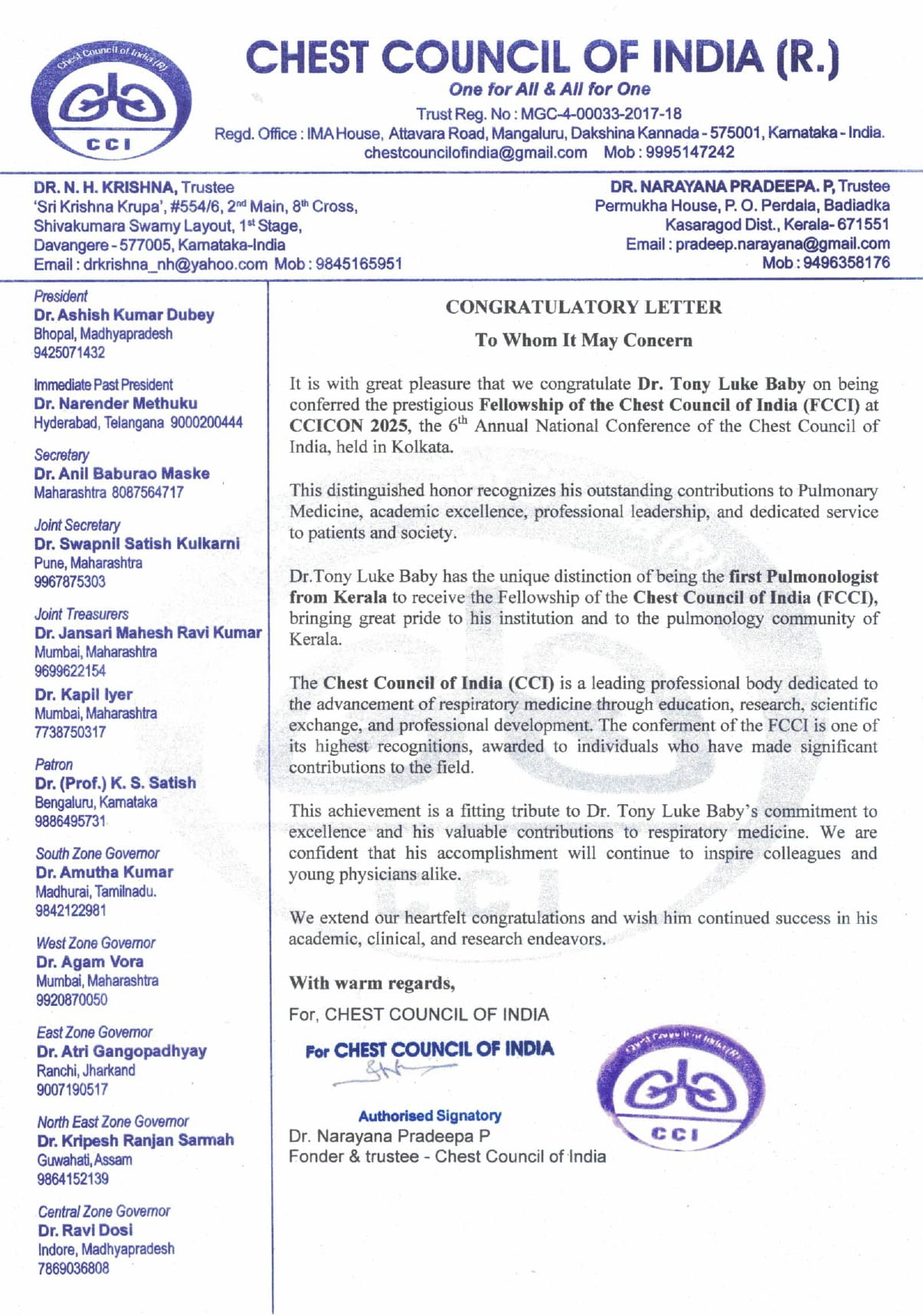
Fellowship of the Chest Council of India
National Speaker: Bronchoscopy Workshop - Taking Biopsies (TBNA/ TBLB), How, When & Managing its Complications.
National Speaker: Main Conference - Inhaled Antibiotics in Bronchiectasis.
National Speaker: Bronchoscopy Workshop - Sedation & Anesthesia for Bronchoscopic Procedures.
Panelist: Transdisciplinary models of care to manage sleep apnea.
Speaker: Inhaled antibiotics (Bronchiectasis): Game changer?
Pro-Speaker (Debate): Should we insert an ICD in a large asymptomatic pneumothorax?
Speaker: New Insights in the Use of Pleural Ultrasound.
Speaker: Pneumococcal Vaccines.
Speaker: Mucolytics for Acute Exacerbations of COPD (Meta-analysis).
Speaker: Benchmarking AI diagnostic accuracy for TB screening (Rapid review & Meta-analysis).
Speaker: Bacteriophages of Mycobacterium TB: diversity & therapeutic uses (Review).
Speaker: Sedation & Analgesia for Fibreoptic Bronchoscopy.
Speaker: PreBronchoscopic Preparation – Anesthesia & Sedation.
Speaker: Sedation & Analgesia for Fiberoptic Bronchoscopy.
DMWIMS Medical College, Wayanad
Speaker: Clinical Aspects Of OSA.
Advanced diagnostic and therapeutic procedures including Thoracoscopy, Lung Malignancy screening, and Biopsies.
Comprehensive care for Adults & Children covering Snoring, Sleep Apnea, and sleep disorders using advanced Polysomnography.
Skin Prick Testing & management for Cough Variant Asthma, Occupational Asthma, and general allergies in Adults & Children.
Specialized care for COPD, Bronchiectasis, ILD (Interstitial Lung Disease), and complex respiratory conditions.
Fitness assessment for Gym, Trekking & Marathon. Pulmonary Rehab including chest physiotherapy and Post-COVID care.
Respiratory Critical Care management. Advanced diagnostics with PFT Unit (Spirometry, Oscillometry, FENO).
Active member of prestigious national and international medical societies, ensuring continuous learning and adherence to global standards.
"Deep Sleep is the best healing tool which everyone has naturally within them."
However, with modern night usage of mobiles, laptops, and TVs, the natural sleep cycle gets compromised over time. This disruption leads to a cascade of health issues including stress, anger, mood swings, gastric disturbances, and lowered immunity.
In adults, this results in a reduction in work quality and family conflicts. For school children and college students, it significantly impacts study focus and retention capacity.
Symptoms like Snoring, Nasal congestion, Night cough, and Night Dry mouth should not be ignored in both children and adults.
If you are on CPAP for Obstructive Sleep Apnea and do not feel significantly better, haven't achieved weight loss, or improved mood within 2 months, your treatment requires immediate modification.
Avoid heavy water intake after 6 PM to prevent night urination and ensure uninterrupted deep sleep. *Heart Failure & CKD patients must strictly follow doctor's fluid restrictions.
Avoid white LED lights in bedrooms. Switch to warm yellow LEDs or bulbs which are soothing and do not disrupt the natural sleep cycle.
Comprehensive answers regarding appointments, sleep health, asthma, COPD, and respiratory treatments.
No addiction is seen usually. Inhalers can be stopped immediately if the condition is manageable on oral medications.
Inhalers are designed for long-term use with minimal side effects because 85-90% of the inhaled molecules reach the actual working site (the lungs) directly. In contrast, with tablets, only around 5-10% actually reach the lungs. Because the dose is lesser, side effects are lesser, making inhalers a better option.
Please don't exercise just to 'test' your condition.
Yes. There is ONLY ONE TEST in the whole world to DIAGNOSE Sleep Apnea: POLYSOMNOGRAPHY (Sleep Study).
If you or your partner notice snoring, disturbed sleep, sudden waking, anger issues, or forgetfulness, a sleep study is mandatory. Always prefer home sleep study screening if possible for a more natural sleep recording.
Note: Before the test, get GERD under control, treat allergies/sinusitis, and avoid sleep meds (like Cetirizine or Melatonin) and daytime naps on the day of the study.
Yes. When you sleep, your heart and body must relax completely to recover. With sleep apnea, you never get good quality sleep due to snoring, hypopneas, apneas, and most importantly, the drop in oxygen supplying your organs.
Because of this, the brain wakes you up to breathe, and your heart pumping increases to improve blood flow. This causes higher cardiac stress during sleep. Consequently, the deeper you sleep (e.g., after alcohol or sleeping pills), the higher the risk of a dangerous cardiac event.
Generally, with good local anesthesia and IV sedation, pain should never be felt during a routine bronchoscopy.
Yes, all interventional procedures have a varying element of risk depending on the route of access, the area being sampled, the procedure type, and the patient's health (including comorbidities like cardiac conditions).
However, these procedures are usually done to "save lives," and they save more lives than cause harm. The specific risk-benefit ratio will be described to you by the treating pulmonologist before the procedure.
All pets can cause allergies. Ideally, you should test for allergies before investing in a pet.
If you or your family members have persistent new allergic symptoms that align with the timeline of getting the pet, you can get a skin prick test done. If positive, immunotherapy can often solve the problem. If immunotherapy doesn't work, then rehoming the pet is the best solution.
Vaccinations are a vital part of comprehensive lung care. The purpose is to reduce infection severity and avoid lung damage (viral pneumonia), though you may still get a mild fever.
All are also recommended for Oncology patients
Cough for more than 8 weeks is called chronic cough.
The following are basic diseases to be ruled out based on the detailed history of the patient:
Get expert opinion for your respiratory health concerns.